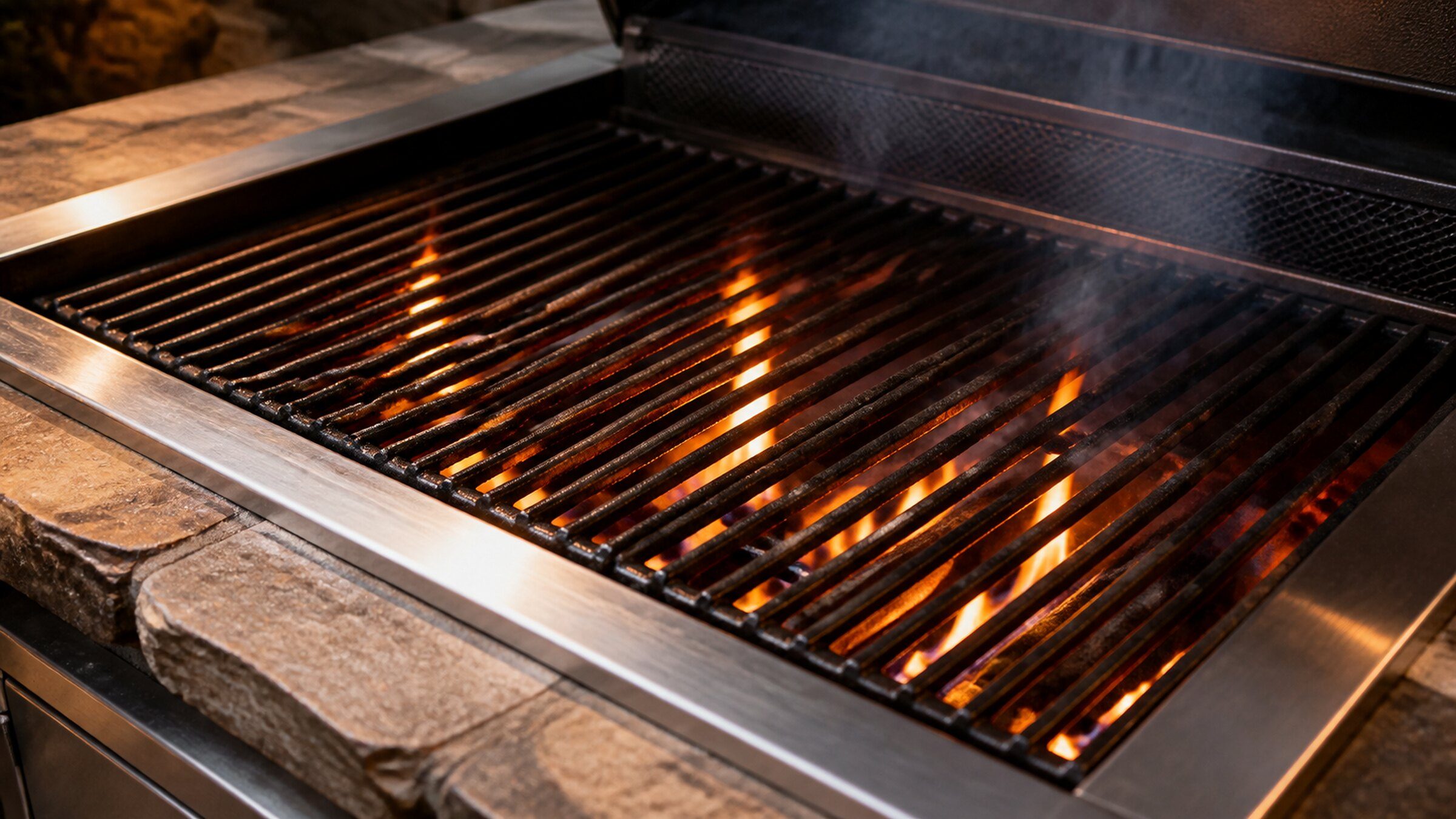
- “Flames rising through the grates”
- “Food scorched outside and raw inside”
- “Heavy smoke that will not settle”
Symptom
Wolf grill flaring up and scorching food
Flames climbing through the grates, food black on the outside and raw in the middle, and a wall of smoke every time the hood comes up. On a built-in grill this is nearly always about where the fat lands rather than about the burners.
- From $95 diagnostic, credited to the repair
- 59 cities and neighborhoods covered
- OEM parts available on order
- In writing the price, before anything is opened
Five ordinary causes
What this usually turns out to be
Cheapest and commonest first, which is also the order we check them in. They sit hundreds of dollars apart, and only the unit settles which one is yours.
-
Fat on the heat plates
What lands on a hot plate burns where it lands, and after a few months there is enough of it to keep a flame standing on its own.
Cooking equipment maintenance from $155 -
A drip tray full, warped or left out
The tray catches what the plates do not. Once it is full — or still in the sink after a clean — the fat goes onto the burners instead.
-
Heat plates corroded through
Holes let fat fall straight onto the flame. Salt air is what turns these into a wear part here rather than a lifetime one.
Grill burner & ignition repair from $195 -
A burner running rich
A lazy yellow flame instead of a blue one makes soot, and soot makes everything above it worse. That one is ours.
Grill burner & ignition repair from $195 -
All burners on high for a fatty cut
A ribeye over full heat will flare on a grill in perfect order. A cooler zone to move it to is the answer, and it costs nothing.
In five minutes
Before you call anybody
None of it needs tools, and all of it makes the visit shorter.
-
01
Under the grates
Cold grill, grates off. Black crust on the plates and pooled fat below are the diagnosis.
-
02
The drip tray
In place, empty, not warped. It is the part most often missing after a deep clean.
-
03
The color of the flame
Blue is right. Yellow and lazy is a burner problem wearing a flare-up costume.
-
04
What was on the grate
Sausages and marbled steak flare. Chicken breast and fish do not. It matters.
How it shows up
What people describe when they call
In more detail
About Wolf grill flaring up and scorching food
The fastest diagnosis is the code
Run the grill empty on high for fifteen minutes with the hood down, let it go cold, then lift the grates and look underneath. Most flare-ups are a season of fat sitting on the heat plates and in the tray, and burning it off is the entire repair.
The part of the grill nobody looks at
Everything above the grates gets cleaned because it is visible. The firebox below them does not, and it is where every flare-up starts: heat plates carrying a crust of burnt fat, a tray that has not been emptied since spring, and burner tubes with grease baked along the top. None of that announces itself until the day a steak sets the whole thing alight.
It is also why this page rarely ends with a part. A grill that flares is usually a grill that is due a proper clean, and the honest version of that appointment is us saying so — or you doing it yourself over an afternoon, which we would rather tell you about than be paid for.
This article is based on:
- Official manufacturer documentation
- Internal repair procedures
- Technician repair history
- Company quality standards
Before you book
Questions about Wolf grill flaring up and scorching food
Is a flare-up dangerous?
A short one when fat hits the flame is normal cooking. A flame that keeps burning after the food comes off is not — that is fat alight in the firebox, and the right move is to shut the gas off at the valve, close the hood and leave it. Do not put water on it.
Should I line the tray with foil?
Please do not. Foil in the firebox traps fat against metal that is supposed to shed it, blocks the drain and reflects heat back into parts not built for it. An empty tray does the job it was designed to do.
How often does an outdoor grill here need a real clean?
Twice a year for a grill in weekly use, which is more than the manual suggests and less than most people fear. Year-round cooking and salt air mean the inside of a Miami grill ages faster than the same grill in a climate with a closed season.
Where we do it
Across Miami-Dade, Broward, and Palm Beach
Same terms everywhere we go: an on-site diagnostic first, the price agreed in writing, and the exact figure confirmed once we have seen the unit.
Neighborhoods people ask for by name
 English